
Logistics is at a turning moment as the needs of efficiency, speed, and flexibility influence the competitive landscape. The logistics sector is governed by human expertise and linear processes in the old model, but as the industry develops, the problems it faces are too complicated to be managed by traditional methods alone.
The logistics sector will need smarter, more flexible solutions to be competitive as global supply chain networks continue to be overburdened by shifting demand, high levels of uncertainty, greater than ever customer expectations, and labor shortages. A revolutionary technology that offers a workable answer to these problems in the supply chain and logistics industries is generative AI.
The Current State of AI in Logistics
By enabling automated processes that offer greater predictive data analytics capabilities, the emergence of generative AI has drastically changed the logistics sector. For instance, generative AI uses deep learning and neural networks to incorporate historical and real-time data into optimal/automated decision-making processes; as a result, generative AI solutions produce higher-value outcomes.
Logistics organizations are now able to become proactive, moving away from responding to forecast results produced by the previous generation Predictive Models using the input of historical data and acting only when those predictions were realized, thanks to effective and proactive solutions developed through Generative AI.
Read: Protecting Patient Records with Laboratory Information Management System
How Logistics Operations Are Changing Due to Generative AI
The introduction of generative AI technology provides an increased level of automation, responsiveness and forecasting capabilities in Supply Chain Management Systems. Additionally, generative AI enables businesses to process vast amounts of both temporal and non-temporal data across many systems, thus enabling companies to utilize resources more effectively and to enhance overall productivity levels by employing advanced machine learning methods.
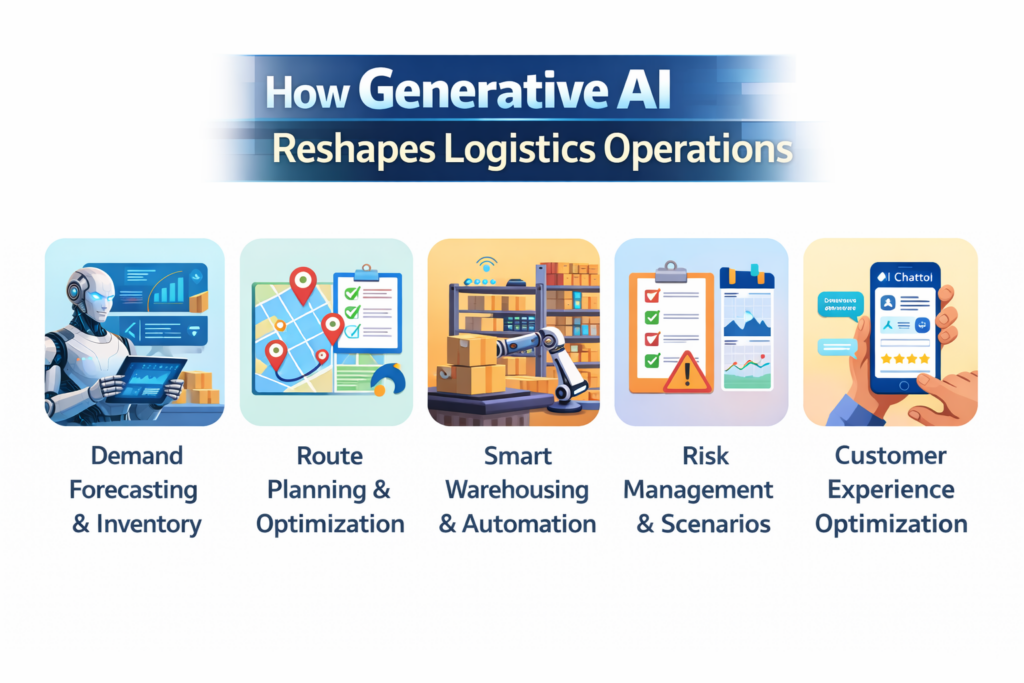
1. Demand Forecasting and Inventory Management
Accurate demand forecasts are critical to logistics operations. In addition to shortages of stock (stock out), which result in unsatisfied customers because the product has not arrived or was not ordered, incorrect computation will raise shipping costs due to overstocking, holding excess inventory for a long time, and the cost of freight and handling to get the excess product to its destination. In order to create demand scenarios for the future, generative AI is a developing application that uses a variety of data sources that were previously used to estimate demand in addition to other elements like weather forecasts, social and economic data, etc.
Additionally, generative AI models will go beyond generating a linear demand estimate. Logistics planners can optimize their inventory levels by leveraging models that simulate various potential future scenarios, particularly in response to unforeseen business disruptions and fluctuating demand spikes (including Temporary Fluctuation and Catastrophic Returns). The model also enables them to plan for distribution of inventory dynamically throughout their network of DC’s as additional inventory becomes available.
2. Transportation Optimization and Dynamic Route Planning
Route planning has traditionally concentrated on reducing the distance or time of travel to finish a delivery since transportation expenses account for a significant portion of the overall cost of logistics. However, due to shifting traffic patterns, road closures, time of day, growing fuel prices, and anticipated time frames for each client, the actual conditions that occur during a delivery are and will continue to vary.
Generative AI may offer Logistics Planners Adaptive Routing Strategies to increase fuel efficiency, shorten delivery times, and lessen the driver’s effort related to timely delivery by utilizing the previously mentioned delivery circumstances. Generative AI will provide you with a new degree of agility and responsiveness in transportation management by utilizing thousands of simulated route variations and real-time sensor data from telematics and IoT devices.
3. Efficient Warehousing and Autonomous Solutions
GenAI enables two key components in warehousing, which is the core of logistics: intelligent design and autonomous fulfillment. Logistics managers’ conventional perspective on the warehouse, including how it is organized and how robotics are used, can be altered by generative AI.
For example, to optimize warehouse placement, generative modeling technology can take into account product access frequency, handling requirements, and seasonal changes. When managing the movements of autonomous mobile robots (AMRs), they can also help reduce congestion in the warehouse and improve productivity.
4. Risk Mitigation & Scenario Planning
Generative AI is beneficial to logistics planning through risk assessment because generative AI is able to create different scenarios based on a “What If?” method. It provides logistics managers an opportunity to create simulations of future scenarios that could include events such as (1) labor strike; (2) extreme weather; (3) political upheaval; and (4) port closures. A logistics manager can therefore create backup plans ahead of time, rather than just relying on data from the past on how disruptions affected delivery times.
By using generative models, logistics managers can thus evaluate the robustness of their supply chain under severe conditions and develop usable, actionable contingency plans. Consequently, using generative models can help Logistics Managers increase agility currently reduce downtime, and decrease susceptibility to shocks on a systemic level.
5. Enhanced Customer Experience
These days, consumers expect logistics companies to be transparent, to provide rapid service, and to offer personalization. Generative AI provides logistics companies with the means to accomplish this through the following:
- User-friendly, intelligent messaging to customers.
- Real-time tracking of products, shipments, etc.
- Personalized delivery options.
As an illustration, generative language models provide logistics companies with a means of automating client interactions. When a client contacts the logistics provider with a question about (1) the delivery timeframe; (2) the potential for disruption; or (3) changes in an order, the generative language model provides the client with an answer that does not depend on a pre-programmed script. Additionally, logistics companies can improve client satisfaction and loyalty through the provision of more accurate delivery estimates based on streamlined delivery schedules.
The Future of Logistics Powered by Generative AI
We may expect more generative AI integration in logistics over the next ten years:
- One of the primary demands is for supply chains to automatically adjust to disruptions in real time.
- AI-human cooperative processes where generative models and planners work together to produce the best possible results.
- Networked, intelligent decision-making is made possible by artificial intelligence-based logistics ecosystems that facilitate smooth data exchange between stakeholders.
To realise this vision, strategic investment, ethical guidelines and an innovative culture are essential to creating leaders in logistics who can harness the full power of generative AI, and do so while balancing ambitious technological objectives with practical operations and maintaining human supervision.
As logistics continue to evolve quickly, organisations that successfully leverage generative AI will have a significant competitive advantage through greater operational efficiency, improved flexibility and increase in customer satisfaction. By working with a reputable generative AI development provider, businesses seeking to integrate generative AI into their logistics will accelerate their innovation efforts and achieve their strategic goals.